Skip to content
In the world of automation, the importance of a well-designed motor control circuit cannot be overstated. According to the International Energy Agency, electric motors consume approximately 45% of global electricity. This staggering statistic underscores the need for optimizing motor control circuits. Industry expert Dr. Sarah Chen emphasizes, “A truly efficient motor control circuit can reduce energy consumption significantly while enhancing performance.”
Designing a superior motor control circuit involves careful consideration of components, configurations, and application scenarios. Each design should reflect a balance between efficiency and reliability. Crafting a circuit that performs optimally is challenging. Mistakes in design can lead to inefficiencies and potential failures in operations. This becomes critical, especially as industries strive for sustainability.
Moreover, emerging technologies like IoT integration require innovative approaches in motor control circuits. The rising complexity of applications often leads to oversight in basic principles, requiring engineers to reflect on previous designs. It is essential to revisit and analyze existing designs to ensure they meet evolving performance standards and energy demands effectively.

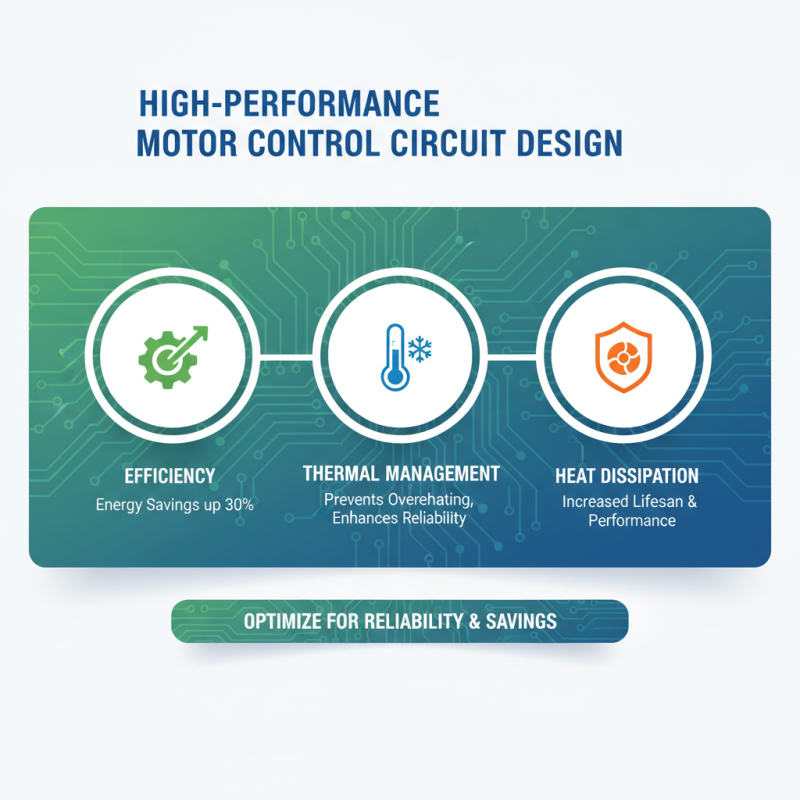
When designing high-performance motor control circuits, several key parameters must be considered. Efficiency is crucial; reports indicate that optimizing efficiency can improve energy savings by up to 30%. Attention to thermal management prevents overheating, a common issue in motor systems. Effective heat dissipation can enhance reliability and lifespan.
Another critical parameter is the selection of components. The right sensors and controllers can drastically affect performance levels. For instance, using GaN transistors can reduce switching losses compared to traditional silicon options. This choice can lead to a performance boost in high-frequency applications.
Feedback mechanisms play a significant role in control precision. Proper feedback loops ensure accurate response to load changes. Yet, improper tuning of these loops can result in instability. Not all designs achieve the desired level of performance initially. Continuous testing and iteration are necessary for success. Optimizing these factors may require reflection and adjustments. This ongoing process is key for achieving optimal performance in motor control circuits.
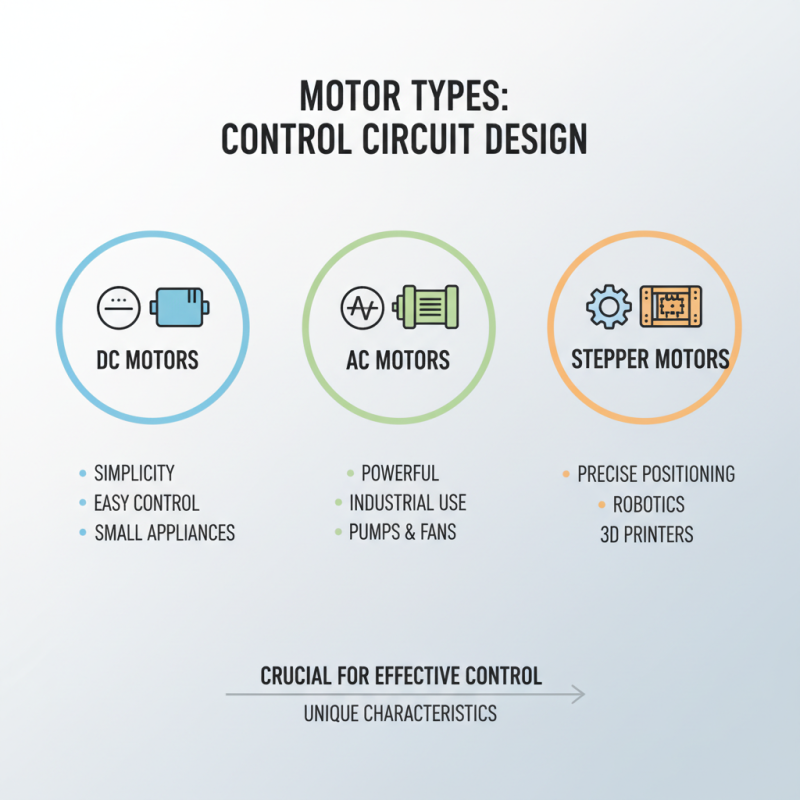
Understanding different motor types is crucial for effective control circuit design. Each motor type, such as DC, AC, or stepper motors, has unique characteristics. For instance, DC motors offer simplicity and ease of control, while AC motors are more powerful and often used in industrial applications. Stepper motors, on the other hand, provide precise positioning, making them ideal for robotics.
**Tip:** Choose the motor based on your application's specific needs. If you require speed control, a DC motor may suit you well.
Control requirements can vary significantly. Some motors may need pulse width modulation (PWM) for smooth operation. Others might require feedback systems to maintain accuracy. Not considering these requirements can lead to inefficient designs and potential operational issues.
**Tip:** Always test your circuit before full implementation. Small adjustments can prevent larger problems later.
Incorporating the right sensors can enhance motor control as well. However, integrating too many features can complicate the design. Simplicity sometimes trumps sophistication in motor control design.
When designing motor control circuits, reliable components are essential for optimal performance. Key elements such as capacitors, resistors, and microcontrollers play pivotal roles. Recent industry reports indicate that the choice of capacitor can increase circuit efficiency by up to 15%. Quality capacitors reduce ripple voltage, enhancing overall durability.
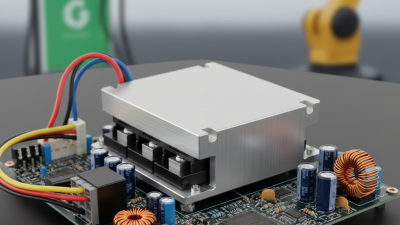
Engineers often overlook heat dissipation, which can compromise circuit integrity. Utilizing heat sinks and proper ventilation can mitigate risks. Studies show that improper heat management can reduce component lifespan by 30%. Monitoring temperature is vital for long-term operation.
Tips: Always choose components from reputable sources. Verify specifications against standards to ensure compatibility. Regularly test your circuits for performance consistency. Keep an eye on advancements in component technology; they can dramatically change design dynamics.
Optimizing energy efficiency in motor control systems is essential. One effective technique involves using variable frequency drives (VFDs). VFDs can adjust motor speed based on demand, which saves energy. This flexibility allows for better control over the motor’s performance. However, implementing VFDs requires careful planning. Improper setup may lead to inefficiencies.
Another method is integrating soft starters. These devices reduce the inrush current when motors start. This minimizes electrical stress and improves longevity. Nonetheless, soft starters may not be suitable for all applications. Their performance can vary depending on the motor type and load conditions.
Energy-efficient motors are also crucial. When replacing older models, look for those that meet current efficiency standards. This directly benefits energy usage and operational costs. Yet, the initial investment can be high. Organizations must weigh the long-term savings against upfront costs. This decision process often involves careful consideration and analysis.
| Design Technique | Efficiency Rating (%) | Cost (USD) | Complexity Level | Applications |
|---|---|---|---|---|
| H-Bridge Configuration | 90 | 50 | Medium | DC Motors |
| PWM Control | 95 | 30 | Low | Servo Motors |
| Sensorless Control | 88 | 70 | High | High-Power Motors |
| Field-Oriented Control | 92 | 100 | High | AC Motors |
| Slip Control | 85 | 65 | Medium | Induction Motors |
| Voltage Control | 80 | 40 | Low | Universal Motors |
| Closed-Loop Control | 94 | 80 | Medium | Robotics |
| Direct Torque Control | 91 | 120 | High | Electric Vehicles |
| IPM Control | 89 | 110 | High | Industrial Drives |
| Chopper Control | 86 | 55 | Medium | DC Applications |
Motor control is crucial for optimizing performance in various applications. Metrics like speed, torque, and efficiency play a vital role in circuits. Understanding these metrics allows designers to make informed choices. For instance, consider a circuit that prioritizes torque. It may not achieve maximum speed but can handle heavy loads efficiently.
Another key factor is thermal management. A circuit that lacks proper heat dissipation can fail prematurely. Similarly, a design might excel in one environment but falter in another. Testing under different conditions is essential. Engineers often overlook this aspect, leading to failures in real-world applications.
Incorporating feedback mechanisms improves performance. Simple circuits may work, but they often lack responsiveness. A design with feedback can adjust in real-time. This captures the essence of effective motor control solutions. Continuous analysis of performance metrics reveals opportunities for enhancement. The path to optimization requires constant reflection and adaptation.