How to Choose the Best Motor Control Solutions for Your Needs
When it comes to optimizing performance in industrial applications, selecting the right motor control solutions is crucial. As renowned motor control expert Dr. Emily Thompson once stated, "The efficiency of your operations hinges on the precision and adaptability of your motor control solutions." This insight underscores the significant impact that well-chosen motor control technologies can have on productivity and energy efficiency.
In today's fast-paced manufacturing environment, decision-makers are faced with a myriad of options for motor control solutions, each featuring unique capabilities and benefits. Understanding the specific needs of your application—be it speed control, torque management, or energy consumption—can help streamline the selection process. This article aims to guide you through the critical factors to consider when evaluating motor control solutions, enabling you to make informed decisions that align with your operational goals.
By exploring different types of motor control solutions and their applications, we will provide you with the knowledge necessary to determine the best fit for your engineering challenges. As industries continue to evolve, leveraging the right motor control technology not only enhances system performance but also contributes to sustainability efforts and cost savings in the long run.
Understanding Your Application Requirements for Motor Control Solutions
When selecting motor control solutions, understanding your application requirements is paramount. Each application may demand specific features like speed regulation, torque control, or precise positioning. According to a report by MarketsandMarkets, the global motor control market is projected to grow from $22.5 billion in 2023 to $30 billion by 2028, highlighting the increasing need for tailored solutions across various industries, including automotive, manufacturing, and robotics. For instance, applications requiring high precision may benefit from servo motors equipped with advanced feedback systems, while those focused on energy efficiency might look towards variable frequency drives (VFDs) that contribute to reduced power consumption.
Moreover, it's essential to consider the environmental conditions and integration capabilities of the motor control solutions. Research by Technavio indicates that over 40% of the motor control systems employed in industrial automation require compatibility with Internet of Things (IoT) technologies for enhanced monitoring and management. This interconnectivity allows for real-time data analysis, essential for applications in sectors like food and beverage, where compliance with safety standards is critical. By thoroughly assessing these application-specific needs, businesses can ensure they select the most effective motor control solutions, optimizing both performance and reliability in their operations.
Types of Motor Control Solutions: A Comprehensive Overview
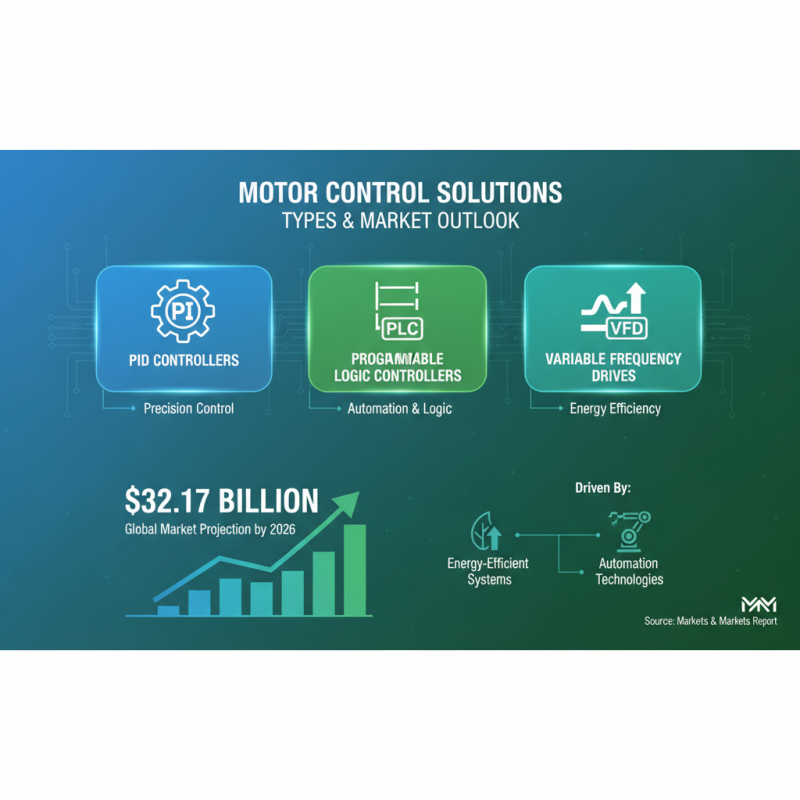
When selecting motor control solutions, understanding the various types available is crucial for making an informed decision. Motor control solutions can be broadly categorized into several types, including proportional-integral-derivative (PID) controllers, programmable logic controllers (PLCs), and variable frequency drives (VFDs). According to a recent report by Markets and Markets, the global market for motor control solutions is projected to reach $32.17 billion by 2026, driven primarily by the increasing demand for energy-efficient systems and automation technologies across various industries.
PID controllers are widely used for their simplicity and effectiveness in maintaining desired performance in systems. They continuously adjust the control inputs based on the error between a desired setpoint and a measured process variable, making them ideal for applications that require precise speed and position control. In contrast, PLCs offer greater flexibility and are suited for complex automation tasks, allowing integration with various sensors and actuators, thus enhancing overall system efficiency. Meanwhile, VFDs are essential for controlling the speed and torque of electric motors, especially in applications where energy savings are a priority, facilitating significant reductions in operational costs.
Choosing the right motor control solution depends on multiple factors including application requirements, budget constraints, and operational efficiency goals. Each type of motor control solution presents unique advantages and challenges, making it imperative to evaluate their features in the context of the specific industrial application. As the industry continues to evolve, staying informed about these solutions is key to leveraging their full potential in enhancing productivity and sustainability.
Key Features to Consider When Selecting Motor Controllers
When selecting motor controllers, it’s crucial to assess several key features that directly impact performance and reliability. First and foremost, you should consider the type of control method that aligns with your application—whether it's open-loop or closed-loop control. Open-loop controllers are typically simpler and more cost-effective, while closed-loop systems provide precise control and feedback, making them suitable for complex applications where accuracy is paramount.
Another essential feature to evaluate is the power rating and compatibility with your specific motor type. This ensures that the controller can handle the current and voltage levels required for optimal operation without risking damage or inefficiency. Additionally, it's important to look at the communication protocols supported by the motor controller, as proper integration with your existing systems or networks can greatly enhance functionality and ease of use. Lastly, consider the thermal management designs of the controllers; efficient heat dissipation is vital to maintain performance and lifespan, especially in high-demand environments.
Motor Control Solutions - Key Features Comparison
Evaluating Cost-Effectiveness and Performance of Motor Solutions
When evaluating motor control solutions, it's essential to consider both cost-effectiveness and performance. Cost-effectiveness involves not just the initial purchase price but also the long-term operational costs, including energy consumption, maintenance, and potential downtime. A solution that appears cheap upfront may lead to greater expenses over time if it requires frequent repairs or inefficient power usage. Therefore, it's crucial to analyze the total cost of ownership and balance that with the expected lifespan and reliability of the motor control system.
Performance metrics such as efficiency, response time, and load capacity play a significant role in determining the suitability of a motor control solution. High-performance motors can lead to increased productivity and reduced energy consumption, which directly impacts profitability. Evaluating these metrics means examining specifications and real-world performance data. By conducting thorough assessments and comparisons, businesses can ensure they select a motor control solution that not only meets their immediate needs but also supports long-term operational goals. This careful consideration helps in making informed decisions that align with both budgetary constraints and performance requirements.
Manufacturers and Suppliers: Choosing Reliable Motor Control Partners
When selecting motor control solutions, identifying reliable manufacturers and suppliers is pivotal for operational efficiency and long-term success. According to a recent industry report by MarketsandMarkets, the global motor control market is anticipated to grow from $12.2 billion in 2021 to $18.7 billion by 2026, reflecting a robust CAGR of 8.7%. This growth underscores the importance of collaborating with partners who not only understand the technological advancements but also adhere to high-quality standards in their offerings.
In the realm of motor control, factors such as product reliability, customer support, and innovation play a critical role in choosing the right partner. Researchers from Technavio have highlighted that companies are increasingly prioritizing suppliers who provide comprehensive lifecycle support and continuous improvement initiatives. Additionally, with the rise of Industry 4.0, it's essential to engage with suppliers who can integrate advanced technologies like IoT and machine learning into their solutions, as these features are becoming essential in optimizing motor performance and energy efficiency. Hence, assessing a supplier's technological capabilities and customer-centric approach can significantly impact the overall effectiveness of the motor control solutions implemented.
How to Choose the Best Motor Control Solutions for Your Needs
| Criteria |
Description |
Rating |
| Performance |
Efficiency in motor control and speed regulation |
⭐⭐⭐⭐⭐ |
| Reliability |
Consistency of operation under varied conditions |
⭐⭐⭐⭐ |
| Support |
Availability of technical assistance and customer service |
⭐⭐⭐⭐⭐ |
| Cost |
Affordability and value for the performance offered |
⭐⭐⭐⭐ |
| Compatibility |
Ability to work with existing systems and technologies |
⭐⭐⭐⭐⭐ |
 Skip to content