How to Choose the Right Power Controller for Your Needs?
Choosing the right power controller can be challenging. Various factors influence your decision-making process. Power controllers are essential components in many electronic systems. They manage voltage and current levels effectively.
When selecting a power controller, consider your specific needs. Think about the application and its power requirements. Not all power controllers are created equally. Some may lack features that are crucial for your setup.
Evaluate the compatibility with your devices. A mismatch can lead to inefficiencies or even damage. Remember that the ideal power controller should not only meet current demands but also allow for future expansion. Keep these points in mind to make a well-informed choice.
Understanding the Basics of Power Controllers
Power controllers play a vital role in various applications. They ensure efficient energy management. Understanding their basics helps consumers make informed decisions.
Power controllers help regulate voltage, current, and frequency in systems. A report from the International Energy Agency notes that efficient controllers can reduce energy consumption by up to 30%. This can significantly impact operational costs, especially in industrial settings. However, many users overlook the importance of compatibility with existing systems.
Choosing the right power controller is challenging. Users often focus on specifications, neglecting underlying system needs. Some controllers may lack user-friendly interfaces. This can lead to operational difficulties, causing frustration. A survey shows that nearly 25% of users experienced inefficiencies due to installation errors. Potential buyers should reflect on their actual requirements. Analyzing past performance can guide them better.
Identifying Your Power Requirements and Load Types
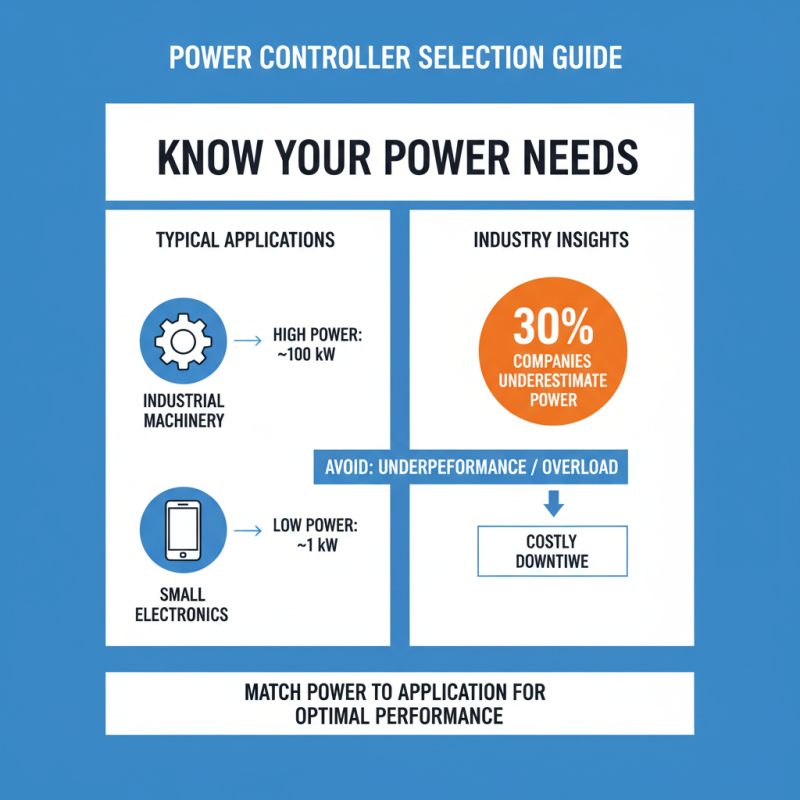
When selecting a power controller, understanding your power requirements is crucial. Different applications need distinct power levels. For instance, industrial machinery often requires a high power output, around 100 kW, while small electronic devices might only need 1 kW. Ensuring you know these specifications helps avoid underperformance or overload scenarios. Industry reports indicate that 30% of companies underestimate their power needs, leading to costly downtime.
Load types also play a significant role in controller selection. Resistive loads, such as heaters, behave differently from inductive loads, like motors. An inductive load can draw more power when starting. This is known as inrush current, which can be five to seven times the normal operating current. Many operators overlook this factor. As a result, they may choose controllers that can't handle these surges. That could lead to equipment failures or safety hazards.
Implementing a detailed assessment of your load profiles can help create a more accurate picture. Gathering this data may feel overwhelming. Still, it's essential for making informed decisions. Analyzing current and future load demands can lead to optimal choices. Your power needs may change over time, so remaining flexible is key. Regular reviews of your requirements will assist in avoiding common pitfalls associated with power management.
Evaluating Features and Specifications of Power Controllers
Choosing the right power controller is essential for optimizing performance. When evaluating features, consider the load capacity. Controllers range from 5A to 100A models. A study by the Energy Efficiency Research Institute found that selecting the right capacity can boost energy efficiency by up to 30%. This impact is significant for industrial applications.
Another critical factor is the control type. Analog controllers provide basic functionality, while digital units offer advanced features. Digital controllers can interface with automation systems. In 2022, industry research indicated that digital controllers accounted for over 60% of market share due to their versatility. Look for features like programmable settings, which enhance operational efficiency.
Finally, don't overlook safety features. Current limiting and over-temperature protection are vital for ensuring safe operations. According to safety reports, inadequate protection led to 20% of power system failures in 2021. Understanding these specifications can guide you towards better choices but be mindful of your specific needs.
Comparing Different Types of Power Controllers Available
When selecting a power controller, understanding the various types available is crucial. There are three main types: linear controllers, switching controllers, and programmable controllers. Each has distinct features that cater to different applications. Linear controllers are simple but inefficient for high-power applications. They provide smooth output but can generate excess heat. Consider this if your project involves energy efficiency.
Switching controllers are more complex but offer higher efficiency. They can convert power with minimal loss. Their design allows them to adjust according to the load. However, they may introduce electrical noise, which could be an issue for sensitive equipment. Think about your devices and their susceptibility to interference.
Programmable controllers provide flexibility. You can set specific parameters for various applications. They are ideal for projects requiring customization. However, they can be user-unfriendly and require a steep learning curve. Assess your technical skills before choosing this option. The right power controller depends on your specific needs and application requirements.
Making the Final Decision: Cost vs. Performance Factors
When choosing a power controller, balancing cost with performance is crucial. Many people focus solely on price. However, this can lead to underperformance. A lower initial cost might come with hidden expenses. For instance, cheaper units often lack reliability and efficiency. This can increase operational costs over time.
Performance factors include load handling and energy efficiency. A controller that can't handle peak loads might feel like a bargain. Yet, it can cause disruptions. You might find yourself replacing it sooner than expected. On the other hand, a premium model could save money in the long run. It could enhance productivity and reduce downtime.
Evaluating your specific needs is essential. What are your energy demands? How often will you use the controller? Making a choice based on price alone can lead to regret. Consider features that matter. Sometimes, spending a bit more upfront can yield better results. Reflect on your choices and seek a balance that suits your situation best.
 Skip to content